


Research
The first auto-mobile
in world history
The history of the automobile does not begin in Mannheim or in Paris, but in Beijing.
In the 1670s, the Flemish Jesuit Ferdinand Verbiest designed a steam-powered carriage at the court of the Kangxi Emperor that moved under its own power. Around 200 years before Carl Benz. The Audi Confucius Institute Ingolstadt has researched the sources and rebuilt the vehicle together with students. And it runs.
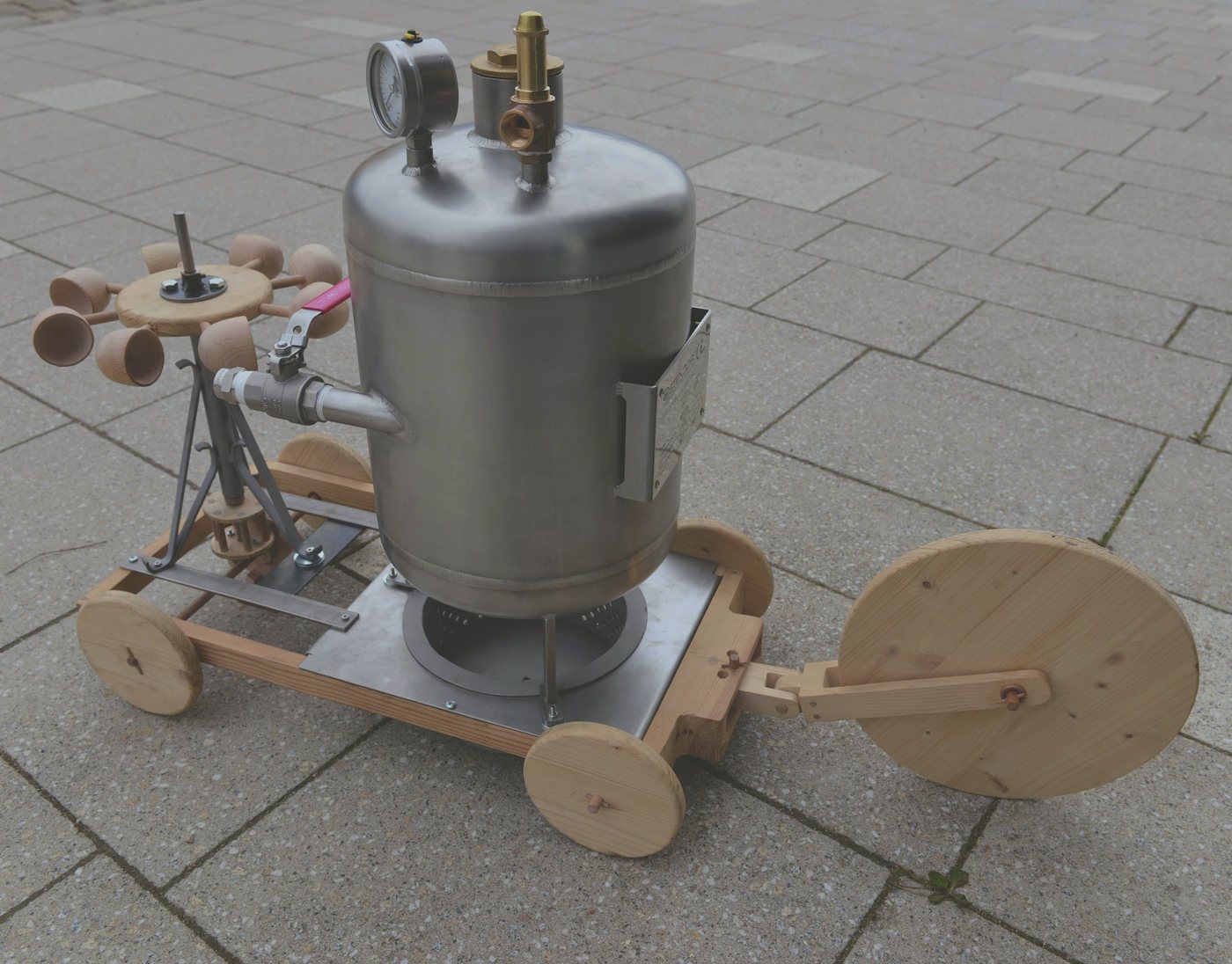
Replica of the Verbiest vehicle with stainless steel boiler and wooden frame
The invention
An astronomer at the emperor’s court
Verbiest was no ordinary missionary. He was director of the imperial observatory, China’s chief astronomer and mathematician, and one of the most important scientists of his time.
His vehicle, barely 60 centimetres long, was a piece of evidence. Nobody could ride in it, and it was not meant to carry loads either. Verbiest wanted to show that steam could make a vehicle move by itself, without being pulled by people or animals. In front of the emperor, it is said, it ran at quite a considerable speed.
From the source to the replica
What was to be proven
The source
Verbiest describes his vehicle in chapter 24 of the “Astronomia Europaea”, printed in Dillingen in 1687. He left no drawing and no construction plan.
The research
Dr. Dr. Gerd Treffer gathered the scattered sources, translated and analysed them. His findings were published in 2018 as the first volume of the institute’s book series and are now also available in Chinese.
The replica
Students from THI and the South China University of Technology developed construction plans under the direction of Prof. Dr. Thomas Suchandt. The replica runs: the first practical proof worldwide.
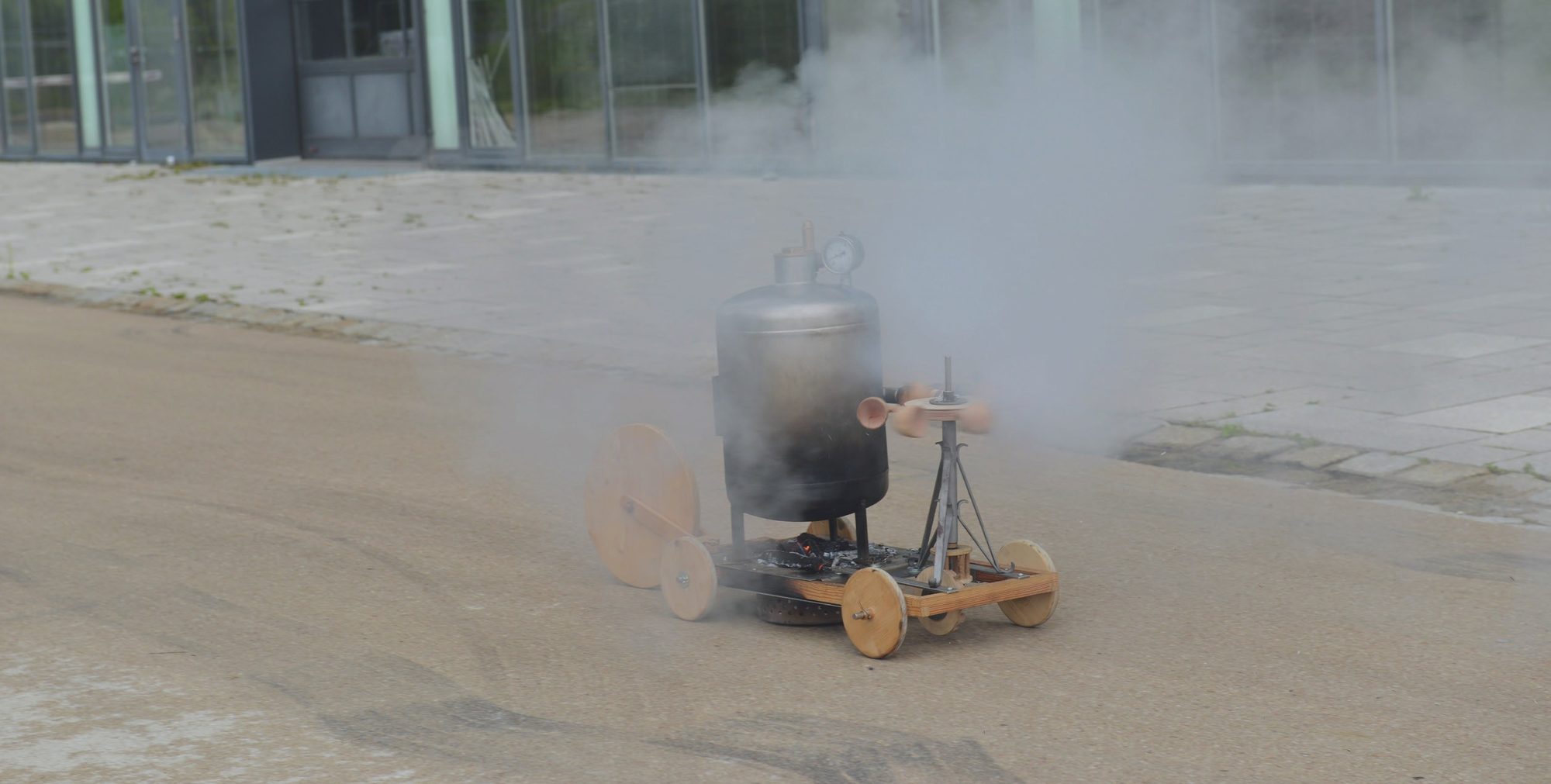
The replica in motion
How the first auto-mobile runs
A coal fire heats the water in the boiler. The steam escapes through a nozzle and drives a paddle wheel, which turns the rear wheels via a shaft. A fifth wheel does the steering, as the steerable drawbar had not yet been invented. Only the boiler is modern, fitted with a pressure relief valve and a pressure gauge for safety.
The first auto-mobile
1678“A journey into the history of technology”
Thomas Suchandt on the replica at THI
- Inventor
- Ferdinand Verbiest (1623–1688)
- Place
- Beijing, court of the Kangxi Emperor
- Year
- 1676/1678
- Length
- 60 centimetres
- Width
- 30 centimetres
- Wheels
- two axles with four wheels, a fifth wheel at the rear
- Steering
- like a ship’s rudder
- Drive
- steam power
- Source
- Astronomia Europaea, chapter 24, Dillingen 1687
- Replica
- Technische Hochschule Ingolstadt, five copies
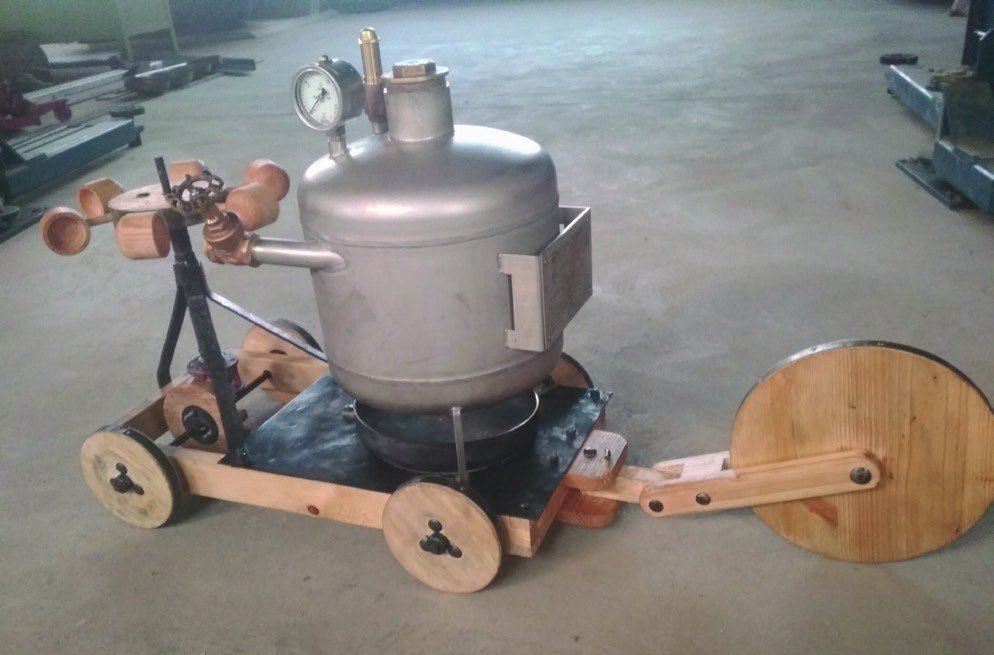
The replica in the workshop
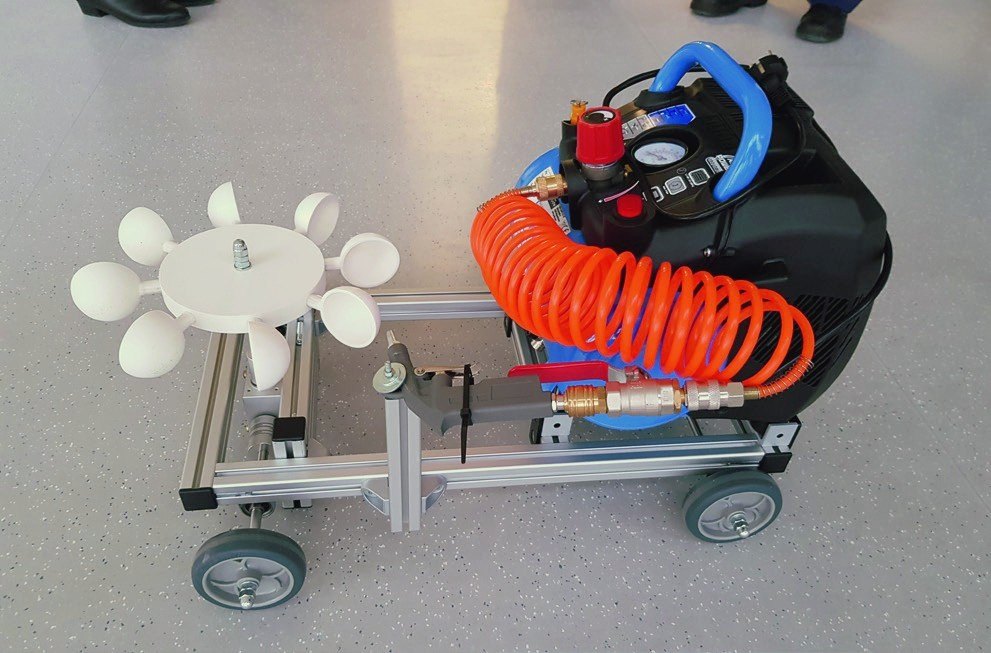
Prototype with compressed air drive
Where the replicas are today
From Ingolstadt to Brussels and Guangzhou.
Today the replicas can be found in museums and at universities. One is on display in the Jesuit room of the Ingolstadt City Museum, received by Lord Mayor Christian Scharpf on 4 April 2023. Another is part of the permanent exhibition of the Autoworld Museum in Brussels. THI and SCUT in Guangzhou, the institute’s two partner universities, have each kept one.
The project connects things that seem far apart at first glance: Ingolstadt, the city of cars, and the roots of the automobile in the Middle Kingdom, historical research and student engineering, China and Germany. That is exactly what makes it so appealing.

The researcher
Dr. Dr. Gerd Treffer
Historian, writer and head of historical projects at the Audi Confucius Institute Ingolstadt. From 1977 to 2016 he was press spokesman for the City of Ingolstadt. He has written numerous books on historical, political and cultural topics and focuses on scientific exchange between China and Europe.
Read his full article in the anniversary magazine →


