AUDI Konfuzius-Institut Ingolstadt
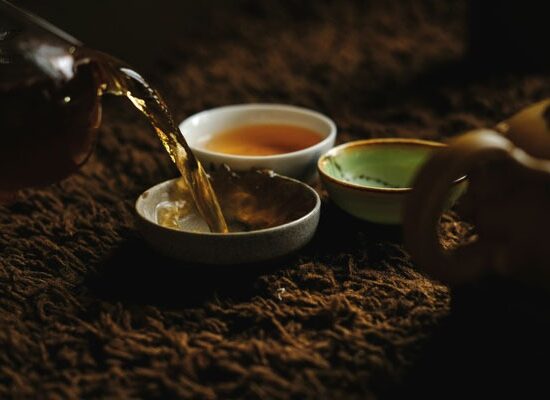
Tee wird aus einer Glaskanne in kleine Teeschalen gegossen

Red oolongs | A path between Wulong 乌龙 and Hongcha 红茶 · In the beginning was the leaf

Online tea tasting

Dark rolled leaves, notes of ripe fruit, jam and spices, with a distinct roasted character: red oolongs show a very different side of Taiwanese tea culture than the well known light high mountain teas.

Their processing goes unusually far towards Hongcha 红茶, red tea, while still staying within the Wulong 乌龙 tradition. With two particularly expressive teas we explore this in-between position: where does Wulong end and where does Hongcha begin? As the teas are of especially high quality this time, there are only two of them. A lovely discovery for the colder months.

How the evening works

Our online tea tasting is a series for tasting together in front of your own screen, relaxed and at your own pace. Tea connoisseur, physician and sinologist Wieland Schulz guides you through the tasting and explains what makes each tea and its region of origin special. You taste the differences in flavour, processing and preparation directly in your cup.

  • 5:30 to 7:30 pm: two hours of tasting with background information and discussion for each tea. Wieland Schulz is happy to answer your questions at any time.
  • If you have Chinese tea ware, feel free to use it. A small teapot or a similar vessel for brewing works perfectly well too.
  • The dates in the series do not build on each other and can be booked individually.
  • The presentation is only available during the event. Have a pen and notepad ready, screenshots of the slides are allowed. To protect copyright and the course content, it is not sent out afterwards.
  • The tasting is held in German.

Registration and tea delivery

  • Binding registration with payment received by Sunday, 29 November 2026. Places are limited.
  • Fee per household and date: €32, reduced €20. A surcharge applies for other EU countries.
  • Right after the registration deadline we send the tea samples to all participants so they arrive in time. For this, your transfer needs to reach us on time.
  • If you book after the deadline, you may get a remaining place via the waiting list. The tea is then sent on the following working day, and we cannot guarantee it will arrive in time.
  • You are welcome to take part from other European countries. Please note that we cannot guarantee delivery on time outside Germany.
  • The reduced fee of €20 applies to pupils, students, trainees and recipients of basic income support. Please send proof as a file to info@konfuzius-institut-ruhr.de.
  • If you do not take part and have not cancelled in writing, the fee remains payable.

The Confucius Institutes in Ingolstadt, Leipzig and Metropole Ruhr organise the series together and look forward to welcoming you.

Date

Thursday, 10 December 2026

17:30 to 19:30

Venue

Online via Zoom
The tea samples are posted to your home in advance.

Fee

€32 per household, reduced €20

Registration deadline

Sunday, 29 November 2026

Places are limited. Registration is binding and confirmed once payment has been received. The tasting is held in German.

All tea tastings →

Strengthening the immune system | TCM lecture series

Talk no. 43 · Online lecture series

In winter in particular, we catch infections more easily, and when they keep coming back, a weakened immune system is often held responsible. From the point of view of conventional medicine, the body’s defences do not work properly when the immune system is weak, which makes it easy for pathogens to take hold.

In Chinese medicine, infections are in principle triggered by different “climatic factors”, such as “wind-heat” or “wind-cold”. But we are not defenceless against them. How severe and how frequent infections are depends directly on our “upright Qi” (zhengqi), which keeps our organism functioning healthily. An essential part of upright Qi is the so-called “defensive Qi” (weiqi), which arises from the interplay of several organs. We will look at why weiqi goes astray, at the most important patterns of disease and at how these are best treated with acupuncture and herbal therapy. Finally, we will discuss the habits and dietary measures we can use ourselves to strengthen our immune system.

In this lecture series, we look at Western clinical pictures from the perspective of Chinese medicine. Starting from the specific diagnosis made in Chinese medicine, we get to know different strategies for preventing these illnesses. We also see which treatments Chinese medicine uses for each condition and what we can do ourselves when we fall ill, through exercise or nutrition. An important part of each talk is the chance to ask your own questions.

Please note: the talk is held in German.

Date

Thursday, 26 November 2026

18:30 to 20:00 · online via Zoom

Access details

Meeting ID: 952 2859 4026

Passcode: 879375

You join via the link above. On a smartphone or tablet you will need the Zoom app first. Meeting chat

Portrait of Dr. Dr. Dominique Hertzer

Dr. phil. Dr. rer. med. Dominique Hertzer

Sinologist and naturopath with her own TCM practice in Utting am Ammersee since 1997. She teaches at LMU Munich and at the universities of Göttingen and Oldenburg.

All talks in the series →

Erkrankungen der Gelenke | Vortragsreihe TCM

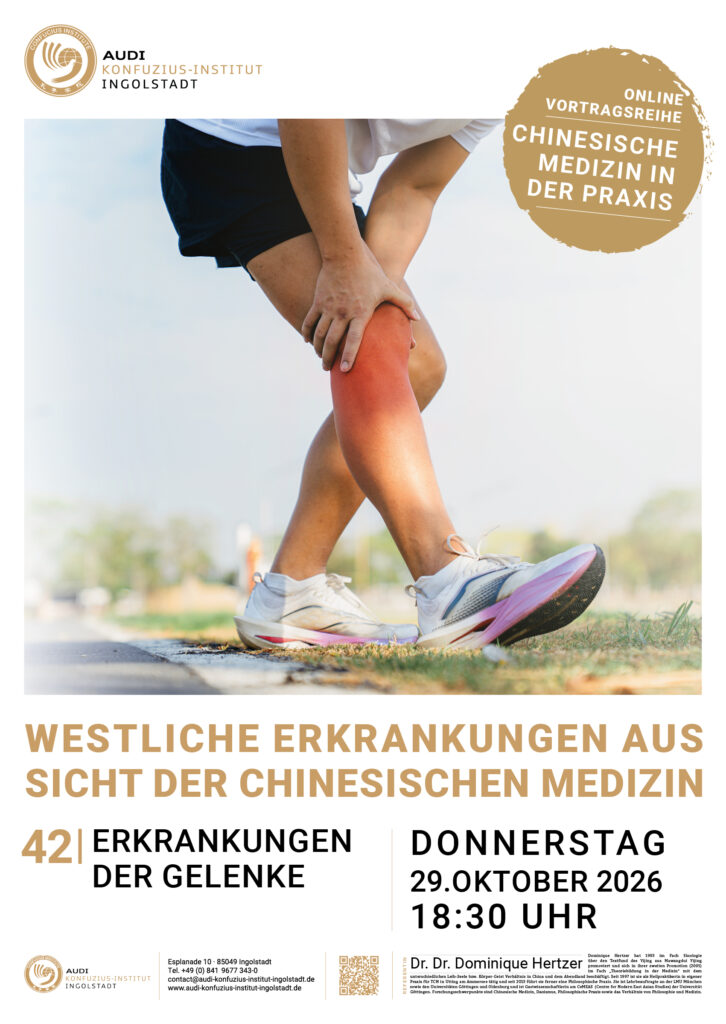
42. Vortrag

Erkrankungen der Gelenke

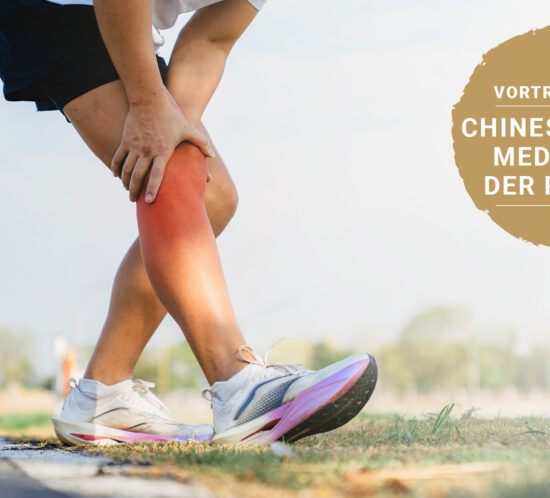
Arthrose der kleinen oder großen Gelenke, Rheumatische Erkrankungen, Muskelschmerzen oder Rückenschmerzen sind weltweit die führende Ursache von chronischen Schmerzen, körperlichen Bewegungseinschränkungen und einer starken Einbuße an Lebensqualität. In der Schulmedizin werden zumeist degenerative Veränderungen der Gelenke, Traumata oder Entzündungen als Ursache für die Schmerzen im Bewegungsapparat betrachtet. Die Chinesische Medizin geht – vor dem Hintergrund des jeweiligen Leitbahnverlaufes – vielmehr davon aus, dass die Schmerzen oftmals durch das so genannte „Bi-Syndrom“ bedingt sind. Dabei handelt es sich um eine Stagnation von Qi und Blut in den Leitbahnen und Gelenken, die wiederum durch das Eindringen „äußerer klimatischer Faktoren“ (Wind, Hitze, Kälte, Feuchtigkeit etc.) ausgelöst werden kann. Doch auch die Emotionen können bei Erkrankungen und Schmerzen in den Gelenken beteiligt sein ebenso wie die Ernährung. Wir werden sehen, mit welchen Methoden die verschiedenen Erkrankungen der Gelenke in der Chinesischen Medizin behandelt werden sowie welche Verhaltensregeln und diätetischen Maßnahmen wir selbst ergreifen können, um Schmerzen vorzubeugen oder sie positiv zu beeinflussen.

In dieser Vortragssreihe werden wir uns verschiedene westliche Krankheitsbilder aus Sicht der Chinesischen Medizin betrachten. Ausgehend von der spezifischen Diagnose, wie sie aus Sicht der Chinesischen Medizin getroffen wird, werden wir verschiedene Strategien kennenlernen, wie wir der jeweiligen Erkrankungen vorbeugend entgegentreten können. Des Weiteren werden wir sehen, welche Behandlungsansätze die Chinesische Medizin bei den einzelnen Erkrankungen verfolgt und was wir selbst im Falle einer Erkrankung tun können – im Sinne von Bewegungs- oder Ernährungstherapie. Ein wichtiger Teil dieses Vortrages besteht schließlich in der Möglichkeit für die Zuhörer eigene Fragen zu den Erkrankungen zu stellen.

Donnerstag, den 29.10.2026, 18.30 – 20.00,

Zoom-Meeting beitreten

Meeting-Chat-Link

Meeting-ID: 954 1819 4331
Kenncode: 084795

Kleine Hinweise zur technischen Voraussetzung:

Eine Teilnahme an dem Online-Vortrag über zoom erfolgt durch den Klick auf den oben angegebenen Link. Falls Sie über Ihr Smartphone oder Tablets einwählen, müssen Sie vorher die App von zoom herunterladen.

Referentin: Frau Dr. phil. Dr. rer. med. Dominique Hertzer

PLAKAT ZUR
VERANSTALTUNG
DOWNLOADEN

Zur Person Frau Dr. Dr. Dominique Hertzer:

Dominique Hertzer hat 1993 im Fach Sinologie über den Textfund des Yijing aus Mawangdui Yijing promoviert und sich in ihrer zweiten Promotion (2005) im Fach „Theoriebildung in der Medizin“ mit dem unterschiedliche Leib-Seele bzw. Körper-Geist Verhältnis in China und dem Abendland beschäftigt. Seit 1997 ist sie als Heilpraktikerin in eigener Praxis für TCM in Utting am Ammersee tätig und seit 2013 führt sie ferner eine Philosophische Praxis. Sie ist Lehrbeauftragte an der LMU München sowie den Universitäten Göttingen und Oldenburg und ist Gastwissenschaftlerin am CeMEAS (Centre for Modern East Asian Studies) der Universität Göttingen. Forschungsschwerpunkte sind Chinesische Medizin, Daoismus, Philosophische Praxis sowie das Verhältnis von Philosophie und Medizin.

Loading new posts...
No more posts